

The best SEO tools in 2026 depend entirely on the problem being solved, not the size of the budget. Picking the most popular platform without matching it to a specific use case is the most common and expensive tool selection mistake Canadian businesses make. This guide covers every major tool category, from keyword research and technical audits to rank tracking, reporting, and AI SEO tools, with a Canadian business lens applied throughout.
Choosing an SEO tool starts with identifying the primary bottleneck, not the most recognized brand name. A site with strong content but no rank visibility needs a tracker, not a content optimiser. A technically broken site needs an audit tool, not a keyword database. Most Canadian SMBs benefit from two to three tools covering distinct functions rather than one enterprise suite designed for agencies managing dozens of clients at a price point that exceeds the actual research and measurement needs of a smaller operation.
For Canadian keyword research, the most reliable options are Ahrefs, which provides strong backlink-correlated keyword data and SERP analysis; Google Keyword Planner, a free tool sourced directly from Google's advertising database and useful for volume ranges; and SE Ranking, which offers strong value for smaller agencies and SMBs managing multiple projects. Canadian businesses should note that CA-region keyword volume frequently returns lower figures than US equivalents. Low CA volume paired with low keyword difficulty is a compensating signal worth targeting, not a reason to bypass the keyword entirely.
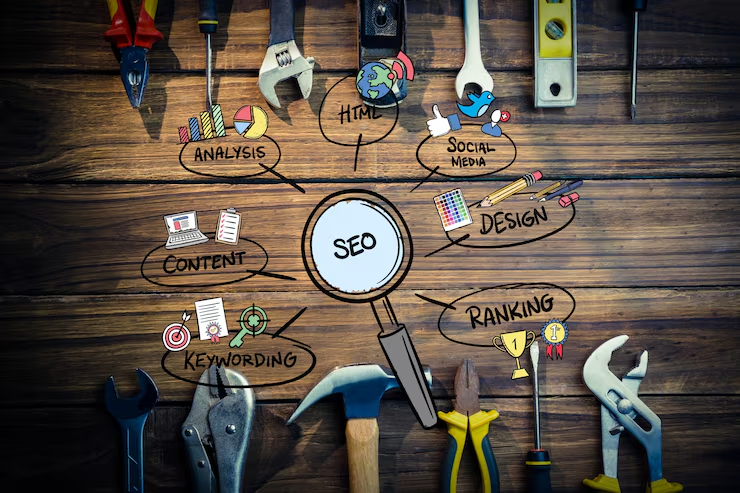
Screaming Frog is a widely used tool for technical SEO auditing. It crawls sites the same way Googlebot does and surfaces broken links, duplicate content, missing metadata, redirect chains, and indexability issues. The free version audits up to 500 URLs, covering most small Canadian business sites without any subscription cost. Google Search Console provides complementary crawl error data at no cost alongside it. For larger sites, Sitebulb and Semrush's Site Audit tool add crawl visualisation and prioritised issue reporting beyond the output a standard Screaming Frog crawl produces.
Google Search Console is the free baseline, showing keyword positions directly from Google without estimation or modelling. For daily tracking and location-specific data, SE Ranking is a strong option for Canadian businesses. Canadian businesses running local SEO campaigns need city-level and province-level tracking configured specifically for Google.ca results. A rank tracker showing national averages for a locally focused business produces misleading data that obscures real market position. Verify that any rank tracking tool differentiates between Google.ca results and country-level aggregates before committing to a plan or building a reporting workflow around it.
On-page SEO tools compare the current page against top-ranking competitors for the target keyword and identify missing topics, under-covered entities, and structural content gaps. Surfer SEO and Clearscope are well-known tools in this category. Both score content against competitor pages and flag opportunities to improve topical coverage within the target word count. For Canadian businesses producing content in both English and French, verify that the chosen tool supports French-language content scoring before committing to an annual subscription, as not all content optimisation platforms handle French Canadian queries with the same accuracy.
SEO reporting starts with Google Search Console for rankings, CTR, and impressions, and Google Analytics for organic traffic, conversion rate, and landing page performance. Both are free and authoritative. Tools including SE Ranking and Looker Studio add dashboard visualisation and automated client-facing report generation. Looker Studio is free; SE Ranking is a paid platform. For Canadian SMBs managing their own SEO without an agency, the free GSC and GA4 combination covers the foundational reporting requirements of a standard strategy without additional cost. Paid reporting tools become relevant when the volume of data or number of stakeholders makes manual reporting the bottleneck.
AI SEO tools in 2026 fall into three categories. AI writing assistants accelerate content drafting but require human editing for accuracy and E-E-A-T compliance before publication. AI content optimisers such as Surfer SEO and Clearscope score content against SERP competitors using semantic analysis. AI visibility trackers monitor brand and page citations in Google AI Overviews, ChatGPT, and Perplexity. This third category is emerging in direct response to AI-generated answers, which are widely reported to be intercepting a growing share of informational search queries. Canadian businesses should prioritise AI visibility tracking for branded and high-purchase-intent queries first.
Growth Hacker uses this category of tools as the data layer supporting every client SEO engagement. Our professionals apply this tool stack across every client engagement — spanning keyword research, technical audits, rank tracking, and on-page optimisation. The value of professional SEO is not access to these tools. Most are available to any business directly. The value is the methodology applied to the data they produce: knowing which signals matter, how to interpret them accurately within the Canadian market context, and which actions drive ranking improvement within a realistic timeline for a site at its current domain authority level.
The most valuable free SEO tools for Canadian businesses are Google Search Console, which provides rank tracking, crawl errors, impressions, and CTR directly from Google; Google Keyword Planner, which delivers volume and competition data from Google's ad database; Screaming Frog's free tier, which covers technical audits for sites under 500 pages; and Google Analytics 4 for organic traffic and conversion tracking. These four tools together cover keyword data, technical health, rank movement, and traffic attribution. They represent the complete SEO measurement baseline for any Canadian SMB operating without a paid tool subscription.

Most SEO practitioners use two to three complementary tools rather than one all-in-one platform. A practical stack for a Canadian SMB: Google Search Console alongside Ahrefs or SE Ranking for keyword research and rank tracking, Screaming Frog's free tier for technical audits, and Google Analytics 4 for traffic and conversion reporting. This combination covers every primary SEO function at a cost well below an enterprise all-in-one suite. Add a content optimisation tool only after keyword research and technical fundamentals are confirmed to be in place and functioning correctly.
Canadian businesses running local SEO campaigns need rank trackers configured to support city-level and province-level tracking specifically on Google.ca, not aggregate country-level data. SE Ranking supports Canadian regional tracking. Ahrefs provides CA-specific keyword data. For bilingual EN/FR keyword research, verify that the chosen tool returns meaningful volume data for French Canadian queries rather than only US or international French equivalents. A tool configured primarily for the US market will not surface the Quebec French keyword opportunities available to bilingual Canadian businesses operating in Montreal and across the broader Quebec market. Growth Hacker's bilingual EN/FR SEO service is specifically built for the Quebec and Canadian market, ensuring French Canadian keyword opportunities are captured alongside English campaigns.
The best SEO tools for Canadian businesses in 2026 are the ones that match the current SEO bottleneck. Free tools cover the foundational measurement needs for most small businesses. Paid tools accelerate keyword research depth, rank tracking precision, and technical audit scope. AI SEO tools are increasingly relevant for content optimisation and brand visibility monitoring in AI-generated search results. Start with the free layer, identify the gap that free tools cannot close, then add one focused paid tool to address it rather than investing in a full suite before the need is confirmed.
Google Search Console is the single most valuable free SEO tool for any small business. It provides keyword ranking data, click-through rate, impressions, crawl errors, and index coverage directly from Google at no cost. Paired with Google Analytics 4 for organic traffic and conversion tracking, and Screaming Frog's free tier for technical audits on sites under 500 pages, a small Canadian business can run a complete SEO measurement operation covering rankings, technical health, and traffic attribution without any paid tool subscription at any stage of the process.
Ahrefs has strong backlink data quality and keyword research depth. It is the preferred tool for competitive link analysis and content gap research. Semrush offers greater breadth across features, including rank tracking, site audits, content tools, and competitor research integrated in one dashboard. Most teams that use both keep Ahrefs for backlink and keyword research and Semrush for rank tracking and content competitive analysis. Neither is universally superior. Use case determines which platform provides more practical value for the specific workflow it is being asked to support.
No. Google Search Console, Google Keyword Planner, and Screaming Frog's free tier cover the foundational SEO functions for most small businesses without any subscription. Paid tools accelerate research, provide daily rank updates, and surface data at scale. They do not unlock SEO capabilities otherwise unavailable to free-tool users. The decision to invest in a paid tool should follow a specific identified gap: a need for daily rank tracking across many keywords, deep competitor keyword data, or content optimisation scoring at a volume and precision that free tools cannot consistently match.
An AI SEO tool uses machine learning to assist with specific SEO tasks. These include content optimisation, keyword clustering, content brief generation, and monitoring brand visibility in AI-generated search results such as Google AI Overviews and ChatGPT responses. AI writing tools generate draft content but require human editing for factual accuracy and E-E-A-T compliance before publishing. AI visibility tools track whether a brand or page is cited in generative AI responses. This is a growing measurement category as AI-generated answers intercept an increasing share of informational search traffic across Canadian and global markets.
Start by identifying the specific SEO problem to solve: poor rankings, low organic traffic, unidentified technical errors, or content that is not converting from organic sessions. Match the tool category to the problem. Rank trackers address visibility monitoring. Technical audit tools address crawlability issues. Keyword research tools support content planning. On-page tools address content depth gaps. Avoid purchasing a full all-in-one suite if only one function is needed. Most Canadian SMBs are better served by one focused paid tool alongside the free Google suite than by an enterprise platform at full price.
For most small Canadian businesses, the free stack covers foundational SEO measurement and research needs without subscription cost. Paid tools become worth the investment when free tools reach a functional ceiling: a site needing daily rank tracking across dozens of keywords, deep competitor keyword gap analysis, or content optimisation at consistent scale. The threshold for most Canadian SMBs is when SEO activity is regular enough that manual free-tool workflows become the limiting factor rather than the data itself. Until that point, the free layer is sufficient and the investment is better directed toward execution.


GET STARTED!
Our SEO agency is dedicated to providing top-notch SEO services, local SEO services, SEO consultation, and SEO improvement. With our comprehensive approach, we ensure your business thrives in the digital landscape. Let us help you achieve your SEO marketing goals with our customized solutions.

.svg)
.svg)
.png)
.png)



.svg)
.svg)